


Earlier this week I saw a headline about the actress Olivia Colman saying in an interview that she describes herself as “a gay man.” There’s little I hate more than listening to affluent white progressives go on about how “queer” they are, but someone asked me for my thoughts on the matter, so I decided to investigate.
I deeply regret that decision.
Before I begin, let me just say how much I admire Olivia Colman as an actress. Even in the shit film she’s currently promoting, she still managed to move me nearly to tears. (Yes, I ended up seeing Jimpa, which I’ll get to in a minute.)
And I’m not even all that bothered by Colman’s “gay man” comment, now that I’ve learned the context. It was during her interview with Them magazine, in response to a question about why Colman likes to take part in films “that include the queer community.” She told the reporter she’s “always felt sort of nonbinary” because she’s “never felt massively feminine” as a female.
Obviously this is a ridiculous thing to say, since we all know that females and males can be both masculine and feminine, and that a person’s gender expression has no bearing on the material reality of his or her sex. But moving on.
After that, Colman said, “I’ve always described myself to my husband as a gay man.”
Here, I don’t think Colman was saying she “identifies” as a gay man, but rather that she “feels” like one. These are two very different things. A straight woman “identifying” as a gay man is cosplay—not all that different from a white woman “identifying” as a black man. But a straight woman saying she “feels” like a gay man likely just means she finds herself responding to the world in ways that are more typical of the gay men she’s known. That is, she strongly identifies with gay men. It’s reductive, of course, since it suggests that all gay men are the same, but whatever. People are dumb.
What jumped out to me in the interview was Colman’s response to a question about her character being someone who is “part of” but also “on the outskirts” of the “queer community.” Colman said that, even though she’s straight, she’s “with queer community a lot.” Then she talked about her experience working on the film, how she’d “never been part of a more welcoming group of people” and she doesn’t understand the “haters” and the “meanies” whose bad attitudes about “queer people” would change if only they’d “come and say hi and actually feel total love.” She got so carried away, talking about all the queer kindness and love, that she forgot what the reporter had even asked her.
Look, I don’t know Colman, so in no way do I mean to suggest that what I’m about to say describes her experience. But as I read this part of the interview, I found myself thinking about a dynamic I’ve seen before in modern “queer” and “LGBTQ+” spaces: people with no sense of proper boundaries nudging empathic liberals into going along with things they might not actually feel comfortable with.
What follows is a fictional example of how this dynamic might unfold in real life.
Olivia, a kind and open-minded liberal woman, is befriended by a group of nonbinary progressives whose lives revolve around anime and whichever protest they plan to attend that weekend. Olivia has never felt so free to be herself, it’s like she can say anything and nobody judges her. Her new friends constantly tell her how brilliant she is, how beautiful, how special. They throw around words like “cishet,” “poly,” and “compersion,” and Olivia is spellbound.
Until one day they’re all at a restaurant, and one of the male friends in the group follows Olivia into the bathroom. Olivia feels weird, having to relieve herself with a man in the room, but then again he’s nonbinary, so he’s not actually a man, right? And while Olivia is trying to do her business he’s standing just outside of her stall, gabbing with her about whatever, like it’s the most normal thing in the world. And now she’s afraid he might be able to see her through the crack in the door, but so what if he can? His online profile picture is a Pokemon, for God’s sake. He’s harmless.
And yet, as they leave the restroom, Olivia can’t help but wonder if that was some kind of test. Like if she showed even a hint of discomfort, then her new friends would realize she’s not as enlightened as they all thought she was. That she might even be a little transphobic. The thought frightens Olivia, so she drops it.
Until two weeks later, when she’s out for coffee with another friend in their group, a woman this time. The woman (who is nonbinary and therefore not a woman, Olivia reminds herself), is talking about Olivia’s teenage daughter, Amelia, whom the woman has met once or twice before. The woman is complimenting Olivia on her parenting skills, going on and on about how special Amelia is. Olivia is genuinely flattered. And then suddenly the woman asks Olivia if she’s ever wondered whether Amelia might actually be a boy. She says the reason she’s asking is because she kind of got the feeling that perhaps Amelia was holding something back—something important about her “identity.” Before Olivia can respond, her friend says that, since she’s trans/nonbinary herself, she’d be more than happy to talk to Amelia, if Olivia ever needed her to.
Now, Olivia knows that she loves Amelia unconditionally, and that she would accept her daughter no matter what. But she also knows that Amelia has never displayed even a hint of gender nonconformity. And isn’t that kind of a requirement, to be trans? Olivia isn’t exactly sure, but she doesn’t want to ask, because she’s afraid the question might come off as ignorant or insensitive.
And so there Olivia is, face to face with her friend, trying as best she can to give off the impression that she’d be totally cool if her daughter came out to her as trans. In fact, she hopes Amelia is trans! And wow, how kind of her friend to offer to speak with Amelia about that.
But as they get up to leave, yet again Olivia finds herself wondering whether she’s just been tested. How would her friend have reacted if she had responded differently? Would she have accused Olivia of being a bigot, of not supporting her daughter, of God forbid, being a danger to her daughter? This thought, too, frightens Olivia. And she knows, deep down, that she never, ever wants this woman talking privately with Amelia about anything.
OK, back to Colman. From the Them interview—in which the reporter also speaks with Jimpa’s director, Sophie Hyde—we learn that the film is based on Hyde’s life experiences, and that Hyde’s “trans nonbinary queer” child, Aud Mason-Hyde, stars as the nonbinary teenager, Frances. Colman plays Hannah, a documentary filmmaker and Frances’s mom. Hannah and Frances, along with Frances’s father, travel to Amsterdam to visit Hannah’s gay activist father, Jim (John Lithgow). (They call him “Jimpa” instead of “Grandpa,” hence the movie’s title.)
Hyde told Them that the idea behind the film was an attempt to put her real-life gay activist father, now deceased, in conversation with Aud. That way, the young “queer” people could learn from the old “queer” people, and the old “queer” people could get it through their thick skulls that all these trans/nonbinary Tumblr teens want is “be really clear with things and liberate all of us a bit more.”
After reading the synopsis and the rest of the interview, of course I had to go see the film, which, just my luck, was playing that afternoon at the Quad Cinema in the Village.
My god, was it awful. Again, kudos to Colman for giving it her all. And to Aud, too, who’s actually a decent actor. But it screams “progressive straight lady makes a gay film.” I get that Hyde actually had a gay dad, so apparently she knows what she’s talking about, but John Lithgow’s “Jimpa” is a caricature of an old gay man. He’s angry and sex-crazed and constantly naked. There are about fifteen slow-motion flashbacks of him dancing around like a queen.
And yet, as horrible as the film was, I’m so glad I saw it, because it perfectly illustrated the queer-people-trampling-boundaries phenomenon I described above.
The boundarylessness wasn’t subtle. Take, for just one example, a scene early in the film, in which Frances is out for coffee with Jimpa and three of his elderly gay male friends. Here are four old men talking graphically about sex with a sixteen-year-old girl. At one point, one man even talks about how much he loves “hole”! In front of a kid!
It’s just gross. I have never in my life known a gay man who’d be comfortable talking that way in front of a young person. And that, to me, is the difference between being gay and being “queer.” One describes a sexual orientation. The other has become an aesthetic of transgression—treating every social norm as suspect, and every discomfort as evidence of repression.
Later in the film, Jimpa hooks Frances up with a much-more-experienced 19-year-old woman, who takes Frances to a cruising ground (as if teenage girls cruise! My god), where they have sex. Then, after Aud tells Jimpa about her first sexual experience, Jimpa says they need to celebrate and coaxes his granddaughter into taking an edible.
And there it was again—the same boundarylessness dressed up as liberation.
What Jimpa reveals—more clearly than the Them interview ever could—is that what now travels under the banner of “queer liberation” often isn’t about expanding freedom at all. It’s about dissolving boundaries and daring anyone to object. Adults speak graphically about sex in front of minors; teenagers are ushered toward experiences they barely understand; mothers are expected to smile beatifically through it all. And if you flinch, even slightly, you risk being cast as a hater or a meanie.
That’s not liberation. It’s social coercion dressed up as kindness. And the more lovingly it’s delivered, the harder it is to resist.
My content on here is free, but your paid subscriptions and donations allow me to keep doing what I’m doing. Thank you for your support!
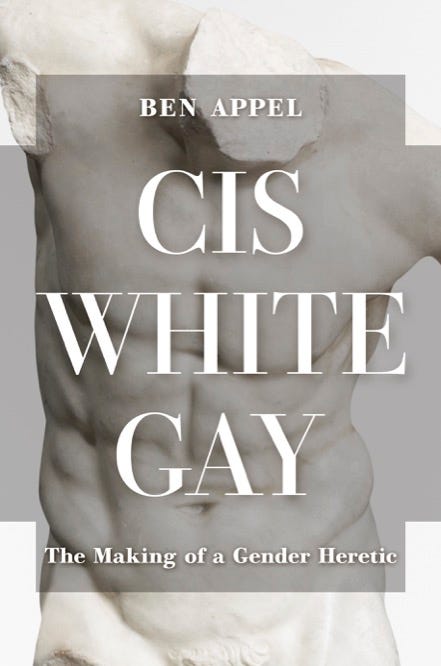
My memoir, Cis White Gay: The Making of a Gender Heretic, is now available.
I am hosting a virtual, six-week-long Cis White Gay book club, starting Tuesday, February 17 at 6 p.m. ET. You are eligible to participate if you have a paid yearly membership. Click the button below to upgrade or purchase a membership. And let me know in the comments or via DM if you’d like to join.
GIVEAWAY: The next three subscribers to purchase a Founding Member plan will receive a signed hardcover edition of my book.
I think you’re circling something important here — not about “queer people,” but about what happens when social belonging becomes conditional on performing ideological comfort.
The dynamic you’re describing — where kindness doubles as a test — isn’t unique to LGBTQ spaces. It shows up in activist politics, corporate DEI environments, religious revivalism, even certain nationalist movements.
The pattern isn’t “queer.” The pattern is moralized conformity.
Where I’d push back slightly is on collapsing a whole identity category into the behavior of its most boundary-erasing subcultures. That risks recreating the same moral simplification you’re critiquing.
The more interesting question might be: When does liberation become norm-dissolution? And how do we protect both dignity and boundaries at the same time?
You nailed it, Ben.
When everything is okay, what's not okay?
"What Jimpa reveals—more clearly than the Them interview ever could—is that what now travels under the banner of “queer liberation” often isn’t about expanding freedom at all. It’s about dissolving boundaries and daring anyone to object. Adults speak graphically about sex in front of minors; teenagers are ushered toward experiences they barely understand; mothers are expected to smile beatifically through it all. And if you flinch, even slightly, you risk being cast as a hater or a meanie."