
This Is What They're Doing
The gender surgeons speak for themselves.

In early February, the American Society of Plastic Surgeons (ASPS) issued a position statement recommending surgeons delay trans-related surgeries until patients are at least 19 years old. The statement cited “insufficient evidence demonstrating a favorable risk-benefit ratio for the pathway of gender-related endocrine and surgical interventions in children and adolescents.” A day later, the American Medical Association announced that it agrees with the ASPS.
Since then, a group of gender surgeons have responded by launching a pressure campaign against the ASPS. Leading the group is Dr. Blair Peters (he/they), a plastic surgeon at Oregon Health & Science University (OHSU). On Instagram, where Peters has over 80,000 followers, Peters is known as “queersurgeon.”
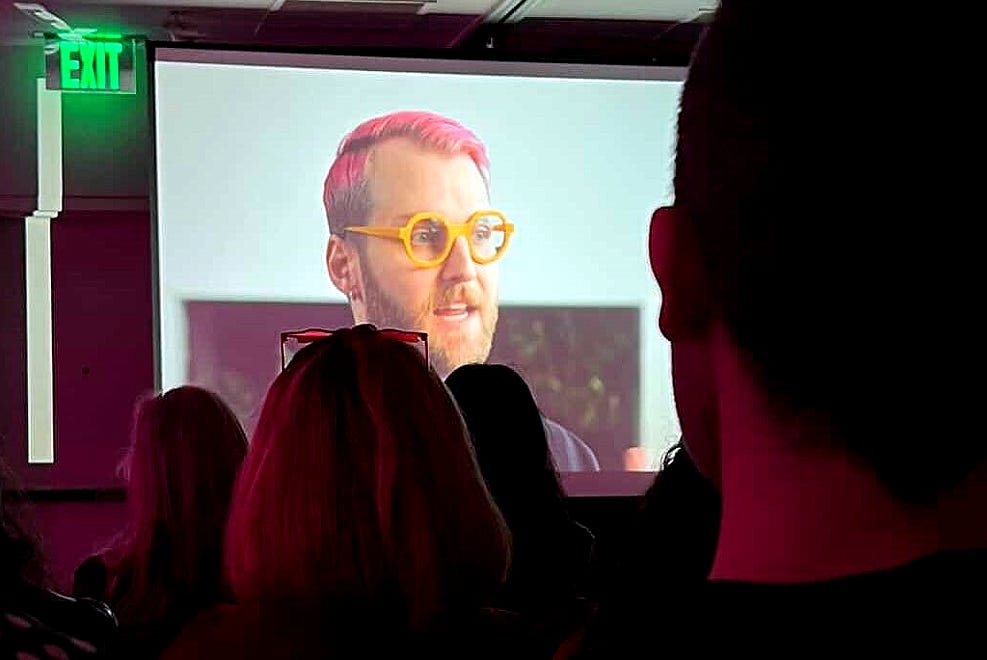
I’ve been familiar with Peters since at least 2023, when I watched an interview he gave to Brianna Durand, a Seattle-based physical therapist who helps post-op “LGBTQ+ folks” with pelvic floor therapy. One of the most surreal aspects of following the issue of “gender-affirming care” has been to hear gender clinicians and surgeons so bluntly describe, often with smiles on their faces, the harm they inflict on the bodies of gender nonconforming children and adults, and for mainstream media outlets and human rights organizations to frame any reaction besides tacit approval as either bigoted or “right-wing.” In this conversation alone, Peters describes in detail horrific forms of abuse—and still, these practices continue.
Peters begins by telling Durand how he tries to refrain from putting his own “bias” on what “binary genitalia” should be. Instead, he chooses to listen to his patients, so that he can create something more bespoke. He asks them, “Where is your dysphoria coming from, what can we fix with surgery, and what is the appropriate level of risk for you?”
“As a surgeon,” Peters says, “my whole goal is helping you self-actualize how you see yourself internally.”
As Durand listens to Peters speak, she becomes noticeably excited. She says she thinks it’s wonderful, the way Peters collaborates creatively with his patients. She asks him for some examples of nonbinary gender-affirming surgeries.
Peters mentions chest surgery—double mastectomy with nipple grafts. Some people who get a mastectomy don’t want to be totally flat, he says. In this case, he leaves something slightly smaller than a breast mound, so that some days they can bind, and some days, if they’re feeling “feminine,” they can have the appearance of a breast.
For genital surgery, he says the greatest variation is what can be done with phalloplasty—the construction of a neo-phallus using skin harvested from the arm, thigh, abdomen, or upper back. Some transmen (females) seek a “traditional” phalloplasty, while others opt for a “shaft-only” phalloplasty. The latter means that the surgeon creates a phallus without lengthening the urethra. (Urethral lengthening theoretically enables a female to urinate while standing.) Omitting urethral lengthening mitigates the risk of strictures and fistulas.
With a shaft-only phalloplasty, there are many options for the remaining genitalia, Peters says. Some females choose to leave it unaltered. Others choose “scrotoplasty”—the creation of something resembling a male scrotum—and to have their clitoral tissue “buried.” Patients might opt to leave the vaginal canal alone for the following reasons: they’re still thinking about bearing children, they still want to enjoy vaginal penetration, or they don’t really have “dysphoria” about the vaginal canal. If a patient isn’t dysphoric about her vagina, why risk the complications? Then there is perineal masculinization, where the surgeon performs everything except a urethral lengthening—that is, phalloplasty, scrotoplasty, vaginectomy (the vaginal canal is sutured shut), burial of the clitoral tissue, et cetera.
A new thing Peters is working on, he says, is “optimizing sensory or erogenous outcomes.” He’s working with a pelvic floor physiotherapist to develop a protocol to achieve optimal “sensory recovery.” This news makes Durand want to jump up and down with excitement. She says that one of the most common complications she sees in her patients is either an inability to orgasm or a weak orgasm. It’s mind boggling, she says, that there hasn’t been more emphasis on optimizing pleasure. This leads Peters to mention the demographic change that has occurred in patients seeking gender-reassignment surgeries in recent years. Patients are now younger, and some males have undergone pubertal suppression (meaning they will never reach sexual maturity). This prevents their genitals from growing, which means there won’t be enough penile and scrotal tissue for the surgeon to construct a neo-vaginal canal following castration.
Durand asks Peters how this has shifted his process. As he answers, his beady eyes dart all over the place.
“The adolescents for sure present some unique challenges,” he says, before quickly stating the trans activist mantra (and blatant lie): “Obviously, there’s great evidence supporting pubertal suppression for a whole variety of benefits.” Puberty suppression isn’t so much an issue with a female who wants a phalloplasty, since they’re harvesting skin from elsewhere on the body anyway. But for males who want a vaginoplasty, pubertal suppression definitely poses a problem.
Peters says the way they’re “dealing with it” is by lining the neo-vaginal canal with peritoneum, which is the inner lining of the abdomen. This allows them to use the little genital tissue they have to “create a vulva and make an aesthetic result.” This procedure involves two surgeons. One (Peters) does “everything externally,” while his partner does “everything robotically and internally,”
Durand asks, “Could you speak a little bit to how that might impact their aftercare or even getting ready for surgery? Is electrolysis still a requirement, or is the need for dilation still as important, et cetera?”
What Durand is referring to here is a male patient’s need to remove pubic hair growth with electrolysis prior to vaginoplasty. Otherwise, hair grows inside the neo-vaginal cavity. Durand is asking about the need for electrolysis in younger males because, if their puberty is suppressed, then it’s very possible they have never grown and will never grow pubic hair. By “dilation,” Durand is talking about the need for a vaginoplasty patient to consistently stretch his neo-vaginal canal with a dildo of some sort, since his body will treat the canal like a wound, causing it to close up. Dilation allows for the wound to be kept permanently open.
Regardless of surgical technique, “lifelong dilation is pretty much the rule,” Peters says. “[The depth] you get in the operating room is never gonna one-hundred percent be maintained.” Real vaginas have “a lot of elasticity,” while neo-vaginas lined with a skin graft or abdominal lining are “not as distensible,” i.e., stretchy. He says that some patients have come back “twenty-plus years” after vaginoplasty, saying they hadn’t been keeping up with dilation and have now lost a lot of depth.
Peters said that he and his colleagues are pretty sure (though not entirely sure) that canals lined with peritoneal flaps are a little bit stronger than canals lined with scrotal tissue during the first couple of weeks post-op. This means they encourage younger patients to start dilation earlier.
Durand says, “You have mentioned previously about folks who maybe have had minimal engagement with their own genitals, either due to dysphoria or just due to the young age at which they’re having surgery after pubertal suppression. Or [they’ve had] minimal to no sexual experiences prior [to surgery] and [yet] after vaginoplasty we’re asking them to do all these high-maintenance things and be really involved with this anatomy.” She asks Peters to talk about “the psychosocial implications of that.”
That is, the psychosocial implications of puberty-suppressed young males with no sexual experience being castrated and then instructed to insert rods into their wounds.
Peters says, “Yeah, it’s something we’ve been talking a lot about in our team at OHSU and we’re kind of writing up our early experience with pedes [pediatric] endocrinology and pelvic floor physio and us as surgeons, and kind of really collaborating to put out, ‘This is our early experience with this group of patients and this is what’s working and what isn’t.’”
With more puberty-suppressed patients requesting vaginoplasty, “it’s coming right at us,” Peters says. “So, as a field we kind of all need to be aware and start thinking about how we can optimize these outcomes.”
In other words, this is one big experiment on young, vulnerable people, many of whom, if left alone, would grow up to be healthy gay men.
Peters continues, “It’s challenging, because there’s this question of how does that factor into consent when you’re consenting someone for pubertal suppression, and there likely is some effect on downstage genital surgery, but you don’t know if an individual is going to desire genital surgery in the future or not.”
Here, Peters is talking about “informed consent.” Critics of the medical transitioning of children and adolescents say that they are too young and inexperienced to adequately consent to treatments that have permanent effects on their sexual and reproductive futures. Trans activists insist that kids “know who they are.” Here, it appears Peters is acknowledging that the informed consent model isn’t as clear-cut as trans activists insist. Does a kid who consents to having his puberty blocked realize this means he might never experience an orgasm? And, being a kid who’s never had a sexual experience, is he capable of understanding what this means? (Of course not.) And does he realize that puberty suppression means he won’t have enough genital tissue to construct a neo-vagina, should he desire one; and that, before he’s ever even had a real sexual experience, a bunch of adults will be instructing him to dilate the gaping wound where his penis and testicles used to be?
Peters says, “It’s also hard to have a conversation with someone that maybe hasn’t [gone] through puberty or [has] never engaged in sexual activity, it’s a really tricky thing. And when it comes time to actually do surgery, if an individual does go through [pubertal] suppression and ultimately is in their latter teenage years and wants a vaginoplasty, not only are you facing the struggle of not having a lot of tissue to work with, but that tissue hasn’t been under the influence of testosterone, which definitely effects some things. And then a lot of patients, just from psychosocial issues and the dysphoria that they’re experiencing, or just blatant transphobia in society, may have not had the opportunity to have a sexual partner, and more often than not there’s been almost no genital engagement in terms of self-stimulation or masturbation, so then trying to assess things like erogenous outcomes after a surgery when someone’s never had an erogenous experience in their life is incredibly difficult, because they don’t really have a baseline to compare it to.”
It is an absolute horror, listening to Peters speak about this.
“And then post-operative care,” he continues. “Anyone [who has] seen a post-op vaginoplasty patient [knows it] is really intense, and we’re kind of asking someone that is younger and hasn’t really engaged or done much with their genitalia to all of a sudden do this really aggressive relaxation for dilation. And it’s just a huge ask. So, we’re finding that to be a barrier almost more so than… Yes, the surgery is technically challenging and demanding, but I think we’re developing pretty good strategies to deal with that. But what we really need is a robust support system.”
Peters adds that he thinks there is going to be “a huge role for therapy” in regard to “giving preoperative genital engagement, trying to have those conversations, preparedness, readiness, support through that postoperative protocol. Because some of the early challenges are getting someone to successfully dilate that’s never had to engage with their pelvic floor musculature and is maybe seventeen, eighteen years old. It’s hard.”
Peters laughs after he says this.
Durand says, “I was talking to a colleague the other day about that because she had a patient who was an adolescent and underwent pubertal suppression and had vaginoplasty. There’s still ongoing conversations regarding the ethics of doing an internal assessment on an adolescent who’s never had any sexual activity or even self-stimulation and their first experience with their anatomy being from this provider or from dilation, which… the symptoms associated with that. There’s a lot of layers to consider.”
One of the “layers” to consider, I think, is whether this is institutionally funded sexual abuse.
Peters says, “There is, for sure, and we’re all having very open conversations, and with patients and families too, trying to figure out what is the best thing. Because, long term, we want people to not only have relief from dysphoria but have a functional and satisfactory, great sex life, too. We’re trying to think like, ‘What can we do ahead of time? Are things like encouraging genital engagement pre-operatively, is that a bad thing or a good thing?’ I don’t think we really know yet in terms of what’s the tradeoff with physical anatomy versus exasperating dysphoria. It’s a very complicated issue and I’m not sure there’s one answer for everybody. But I think [it’s] definitely something that we’re gonna learn a lot more about in the next five to ten years, because we’re doing just increasing numbers of these [puberty-suppressed] cases, and I think [that] applies for all of y’all doing pelvic floor physio, too.” He laughs again. “I’m sure we’ll be in close communication.”
“It will be fascinating to see how that unfolds,” says Durand. “I hope we see more research rolling out regarding assessing the efficacy of different interventions. You mentioned how intense post-op care is after vaginoplasty. It’s becoming increasingly common for folks to opt for a vulvoplasty, I believe is how you referred to it, [which is] a minimal or no-depth vaginoplasty. What trends do you notice in terms of how this impacts outcomes?”
Peters says, “I think everyone runs their practices a little bit differently, and it kind of comes down to, again, like, what I was saying with the binary bias of things. But I see a lot of patients that come in from all walks of life, all different backgrounds, all different ages with varying degrees of social supports. There’s a lot of people that come in like their sixties or seventies with other health issues and conditions who don’t have a partner to help them through surgery, maybe don’t have stable housing, all these other barriers. Sometimes you just start talking to someone and they’re just so dysphoric from their genitals, they just don’t want to be dysphoric, and they wanna have comforting clothing and be able to change in a public bathroom or a restroom or a locker room and just feel like they don’t have male genitalia. And for those people, vulvoplasty is great, and a lot of them don’t even know that it’s an option because a lot of people I don’t think take the time to really have that conversation. And it makes a huge difference in terms of what someone’s preparation looks like with a vulvoplasty. You don’t need any electrolysis because there’s not internal tissue, you don’t need to dilate at all post-operatively, so it’s a much swifter and quicker recovery, and for many patients that don’t desire sexual penetration, those are kind of the two questions. Like, do you desire sexual penetration? And are you dysphoric from not having a vaginal canal, or will you be dysphoric from not having a vaginal canal? If the answer is no, the next question is, why are we doing a canal? Because that’s where the big [risk] of rectal injury and urinary incompetence and all of those things start to come into play.”
A few years ago, I interviewed Shape Shifter, a gay man who is suing Boston Fenway Health, the hospital that performed his vaginoplasty, from which he has suffered severe health complications. (Shape’s suit states that Fenway’s “deliberate failure to identify internalized homophobia, a contra-indicator to transgender affirmation, denied [him] the benefits of healthcare on the basis of sex and sexual orientation, and made him the subject of unnecessary and harmful medical interventions.”) During our conversation, Shape spoke about the differences between trans-identified gay men and trans-identified autogynephilic (AGP) men. AGP men typically don’t desire to be penetrated, he said. They just want the sexual gratification of having something that looks like a vagina on the outside. Since they don’t need depth, Shape believes they’re the ones who are typically happiest with surgical outcomes. The homosexual transsexuals like him are the ones who suffer. Not only is it difficult to maintain depth, but they often have incontinence issues and experience fistulas and recurring infections, which severely limits the possibility of penetration. Even anal penetration becomes too painful because of the complications in that area. Again, the AGP men are the ones driving the demand for this, said Shape. The homosexuals are suffering. And this is why adult AGP males should not be influencing healthcare policies for gender nonconforming, proto-gay youth.
Peters tells Durand, “For a lot of our patients, some of our adolescents, for example, who are not sure if they want a canal, we’ve done a couple of vulvoplasties just to sort of relieve dysphoria, have them live in that body for a couple of years, and then make that decision for themselves when they’re maybe ready for sexual penetration or dilation and they’re in a better place in their life.”
That is, they castrate an adolescent male and construct something that resembles female genitalia on the outside. Then, in a few years, if the patient decides he wants to be penetrated neo-vaginally, he comes in for yet another genital surgery.
“So,” continues Peters, “we’re kind of starting to stage a little bit in certain cases, too, where maybe someone’s not fully ready for a vaginal canal or not sure that they want one, or some people that embrace more of a trans-feminine, nonbinary identity and they feel a vulvoplasty is better in line with how they view themselves internally. So, there’s really a lot of different reasons why someone wants a vulvoplasty. Sometimes it’s just [that] they don’t want the risk of a canal or they have barriers to electrolysis and dilation and don’t want to deal with that. Or it’s just how they view themselves in their gender identity. But I would say, over the last year, like, thirty-plus percent of patients have come and actually requested vulvoplasty. I do say, I think we’re a little bit different geographically in Portland and on the west coast, where I feel like we just have a lot more sort of nonbinary, queerness, fluid identities, versus places like New York, [which] seem to be very binary.”
Peters is smug.
“So, I think part of it is geographical, but I think part of it is, that’s our whole style,” he says. “You kind of tell us and we figure out what’s best for you versus you can come in for one of these two things.”
That is, it’s consumer-driven “healthcare.”
Durand asks if it is difficult to create a canal after doing a vulvoplasty.
“Yeah, so, disclaimer with that,” Peters says. “I’m definitely not saying that that is the right thing to do for everyone, because it is more complicated and it is a whole second surgery. So, if you know you want a vaginal canal, you just do a vaginoplasty. But that’s where being able to offer robotic vaginoplasty is a game-changer, because we can line almost all of the canal with peritoneum. Because, traditionally, all of the skin you’re lining the canal with is all that scrotal skin that you’re discarding [if you do a vulvoplasty]. So, if someone’s gonna get a secondary canal after a vulvoplasty and you can’t do robotic surgery, you’re gonna need to take a skin graft from somewhere else. But we usually don’t have to do that if we’re doing it with the robot, so we reserve that for patients that are, like, ninety percent sure they want a vulvoplasty, but they’re just, like, not totally sure whether or not they’ll, like, want sexual penetration in the future, but they have no plans, they don’t have a partner, and maybe, like, they’re at a place in their life where it’s also gonna be really difficult for them to do that care. It just keeps the door open. Or you know, like I said, for the odd adolescent that is really dysphoric and needs that part of it addressed but isn’t at a place where they’re ready for a vaginal canal, we do find that to be a useful thing. Anecdotally, it’s too early to say what the conversion rate is in terms of people coming back for canals. But in the last year, having done quite a few vulvoplasty and that type of scenario, the vast majority of people are ecstatically happy and I don’t think are gonna pursue a canal any further. It is doable, but it has to be done typically robotically. It could be done sort of from the traditional perineal dissection, but it would definitely be higher-risk. But as far as for robotic surgeons, it’s a very doable thing.”
Durand says she has a lot of pelvic-floor physical therapy patients who have had vulvoplasties. She says they often have partners with vulvas (meaning their partners are women, thus, they are probably autogynephilic). She asks Peters if he knows of any research examining that. Peters mentions a paper—either one that is currently underway or that has already been published in a professional journal—about the percentage of people seeking vulvoplasty. The subjects were asked if they viewed it as any less female with or without a canal, and the answer was no, they viewed it just as fully feminine, at least in their own internal sense of self. He said that he thinks a lot of people do need canals to have their dysphoria relieved, but some people just got them because they didn’t know anything else was an option. He mentions “binary bias” again. He highlights the importance of a consultation, where the surgeon can learn the patient’s goals and priorities. Does that person want to be comfortable in a locker room? Are they worried about aesthetics? Erogenous sensation? Desire for penetration? Patients can rank these things in order of priority.
Peters says, “I would much rather do a vulvoplasty and have a small chance someone will want a vaginal canal in the future and do a slightly more complicated surgery, then having the more common thing of a person that isn’t really wanting the canal and doesn’t use it and isn’t doing a good job dilating and then all of a sudden is having these pelvic floor issues and chronic discharge and infections. It just becomes a huge mess.”
A huge mess, this supposedly “life-saving care.”
He continues, “So, I think it’s better to just avoid those things unless they truly need them. I would feel much better about a conversion canal than trying to take away a canal, which is very hard to do. So that’s kind of my personal opinion, I guess.”
Durand takes a few moments to fawn over Peters. “I love the idea of ranking the priorities and the outcome. I also love hearing you reiterate how having someone’s dysphoria be relieved is usually the most important thing. I’m pretty sure that in all of medicine we could all do a lot better about leading with that and having that open discussion as opposed to just laying out ‘options’ for folks and not really letting them be part of that collaborative decision-making. You’re definitely doing all the advocacy, I see you out there trying to change the world, you’re doing it.”
Peters appears to enjoy this.
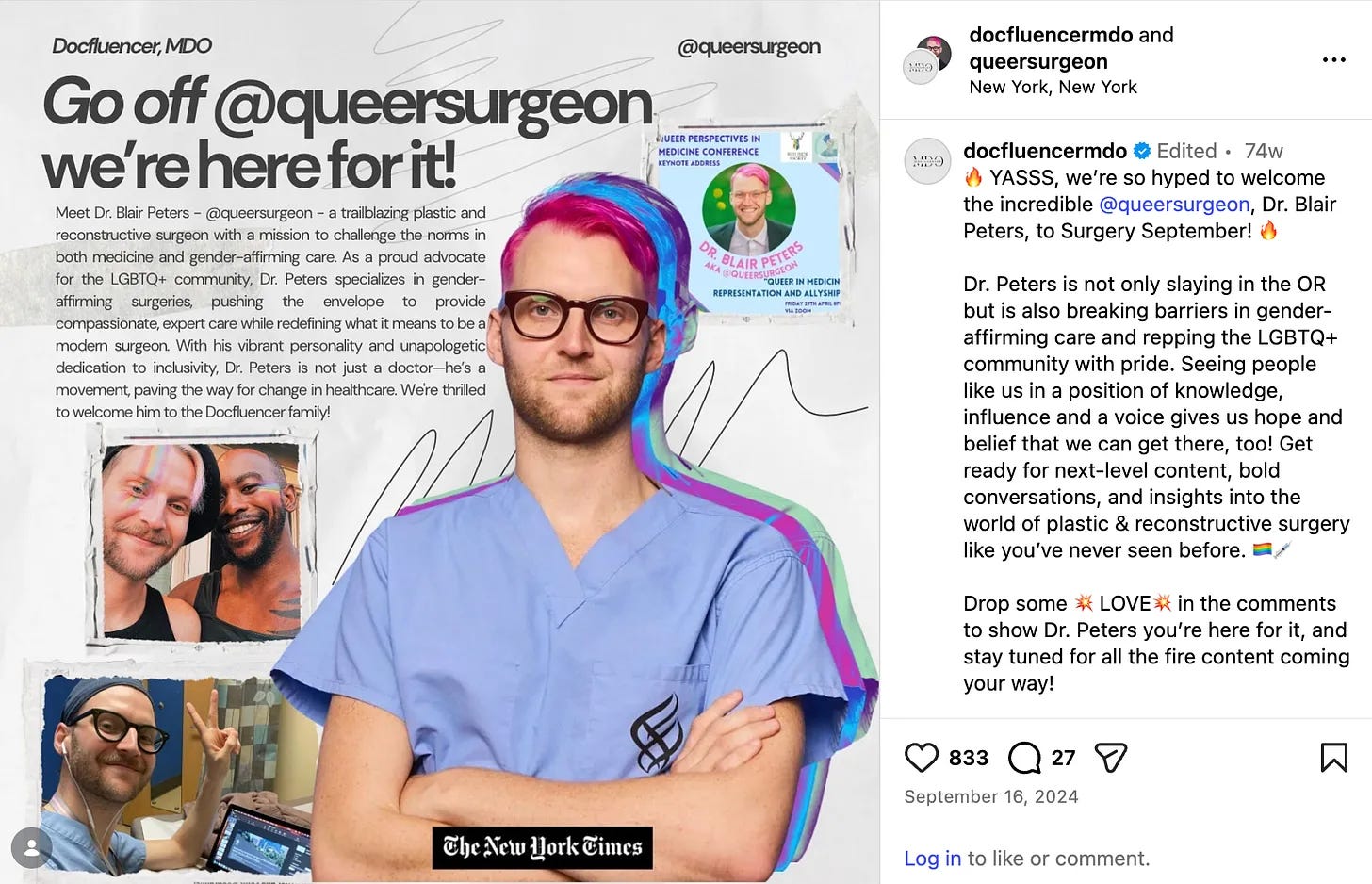
Durand continues, “On your social media you speak openly about your identity as a queer person and your struggles with how this intersects with your role in the medical field. I saw a post you had about mentorship recently, I thought that was phenomenal. Would you mind sharing some examples of how being part of this community influences your surgical practice?”
“I don’t even know how I would do this if I wasn’t queer,” says Peters. “Like no shade to non-queer surgeons.” He laughs. “Like, we need all of you. But it’s such an amazing thing, I think, for me to just feel like I’m at work treating my community and, like, looking after people that I would otherwise hang out with at Pride or at a queer bar or a safe space, and being able to show up to clinic with, like, pink hair and jeans and a T-shirt, and no one is questioning my professionalism or competency to do surgery. And I think also understanding the language and the culture and being able to just go into a room and have patients have these very comfortable conversations with me about sexual practices or preferences or polyamorous relationships or how all of these things are going to interplay into what they ultimately want for themselves. So, I think it’s a huge asset in terms of almost instantly walking into a room and just creating an environment where we have rapport just courtesy of our presentation and connection to community ties. And I do speak a lot about that, of why visibility is so important, because visibility allows for you to meaningfully represent a community of people which not only leads to better care for them but it leads to a better sense of satisfaction for you, coming to work as your authentic self. So, I couldn’t imagine a better position for me to be in. I think there’s nothing more powerful or more professional than someone really loving themselves enough to show up to work authentically and just to take pride in what they do, and whether someone agrees or disagrees with you on that, I think they’re gonna respect you regardless because everyone else around you will.”
“So beautifully said,” says Durand. “It’s deeply fulfilling, I have to agree. Similarly, I don’t think I could be doing this if I wasn’t part of this community. There’s just something unspoken about it and it is so fulfilling to see that. And I really love that you speak so much about representation and you’re always talking about how there’s people, med students in your DMs, talking about how much you’re inspiring them.”
The video of this conversation between Durand and Peters eventually went viral on social media, and many people who saw it were rightly horrified.
During a Florida hearing on laws regarding transgender medical procedures, when Republican Congresswoman Kat Cammack wanted to play a video of the interview for the court, Democrats, in protest, stormed out of the room. Apparently they’d rather not know what they keep voting for.
My memoir, Cis White Gay: The Making of a Gender Heretic, is now available!
My content on here is free, but your paid subscriptions and donations allow me to keep doing what I’m doing. Thank you for your support!
I am hosting a virtual Cis White Gay book club. Our first meeting was this past Tuesday, and it was fantastic. We are meeting for the next five Tuesdays, at 6 p.m. ET. You are eligible to participate if you have a paid yearly membership. Click the button below to upgrade or purchase a membership. I will make sure you get an email with sign-on instructions.
GIVEAWAY: The next two subscribers to purchase a Founding Member plan will receive a signed hardcover edition of my book.

I could only skim through this parade of horrors, but thank you for shining a light on the medical scandal of the century. Democrats should have hell to pay for colluding with this madness.
Obscene from start to finish. Criminal. Horrifying. Mengele-level abuse.
I have restacked the hell out of this, Ben.
But the Democratic Party is only doubling down on this insanity. I am so furious I could spit. I won't vote in the coming election. For the first time in my life, 50 years of voting, I refuse to vote. I sure as hell won't vote for the fascist MAGA party that is trying to destroy this country, but I also won't vote for any Democrats, because so far, they're all aboard the trans train.